Frequently Asked Questions
It’s not always obvious what questions to ask when buying jewellery.
We offer the information below as a guide.
~ Helen and Brian
-
Jewellery set with precious stones is usually made from 18ct gold, but 9ct gold is often chosen for economic reasons.
Pure gold is 24ct, being 1,000 parts of gold. Therefore, if a ring is made from 18ct gold, 750 parts are pure gold and the remaining 250 parts are alloys.
The alloys are a combination of metals and the quantity of each alloy used determines the end colour – yellow, white, red or green. For instance, red gold contains a greater percentage of copper; to make white gold the alloys might include zinc or palladium.
As a manufacturer, we are able to choose which grade of white gold we buy. We have chosen to use the highest quality available. The alloys in our gold include palladium and platinum, both of which are very white metals. Our gold does not contain any nickel (which is known to cause allergic reactions in some people).
Top grade white gold costs a little more than the gold containing cheaper alloys, but we believe that it is in our clients’ best interests to manufacture our product from the top-quality gold.
-
Rhodium-plating of white gold rings is a worldwide, industry-recognised practice in order to create the whitest possible appearance.
The plating does wear away gradually; its lifetime is determined by the lifestyle of the wearer but also by the thickness of the plating applied by the manufacturer.
Unfortunately, some white gold jewellery sold in New Zealand – predominantly imported items – is of a very yellow hue due to the cheap alloys used. This is not apparent when new if the item has been rhodium-plated. However, in order to cut costs, the layer of rhodium-plating applied is often extremely thin, so it wears off within a very short time. In some cases, yellow gold rings are rhodium-plated on specific parts such as settings and shoulders, giving the appearance of a two-tone ring. This lowers the cost of the finished item markedly but is not good practice because the plating will wear off very quickly. Such jewellery is inferior. Two-tone rings should be made in two parts, using yellow and white gold.
We pride ourselves on producing a top-quality product, and on educating our clients so they can make an informed choice.
-
The New Zealand standard for platinum is 950 (95% purity), as opposed to the standard of 850 (85% purity) accepted in many other countries. It is also 40% heavier than gold.
Because it is 95% pure, platinum jewellery does not change colour or tarnish, and it keeps its brilliant white lustre for a lifetime.
Platinum is a naturally white metal, which helps enhance a stone’s brilliance and depth.
Its purity makes it hypoallergenic, making it an ideal choice for people with sensitive skin.
-
“Conflict Diamonds” are rough diamonds used by rebel movements to finance wars against legitimate governments.
Countries such as Sierra Leone, Angola, Liberia, Guinea, the DRC, and the Ivory Coast produce less than 1% of the world’s diamonds, and that 1% is predominantly industrial and “near gem” quality, ie they are unsuitable for jewellery.
The Kimberley Process (to which New Zealand is a signatory) is a joint governments and industry initiative to stem the flow of conflict diamonds. It ensures that every legally imported diamond will be from a verified and controlled source.
The diamonds we supply are purchased from legitimate sources not involved in funding conflict.
-
The Mohs hardness scale is a qualitative 1-10 ordinal scale, developed in 1812 by German mineralogist Friedrich Mohs. It provides a straightforward method for determining a mineral's resistance to scratching or abrasion.
It ranks soft minerals (1, talc) to hardest (10, diamond), where a higher number mineral scratches a lower number one. It is widely used for mineral identification and assessing gem durability.
The scale measures only resistance to scratching, not a mineral's overall durability or toughness against impacts. This distinction is crucial – some minerals with high Mohs hardness can be quite brittle and break easily when struck (like diamond), while softer minerals might better withstand impacts without fracturing.
A Little Drop of History…
-
Despite common usage, the definition of a “jeweller” is “A person who deals in or sells jewellery”.
The term “goldsmith” goes right back to the 14th century when the Goldsmiths Hall was established in London, and by definition is “A skilled artisan who specialises in designing, crafting, repairing, and selling jewellery and other decorative objects made primarily from gold and other precious metals. They are experts in manipulating metal through techniques like melting, casting, and polishing to create unique, high-quality pieces.”
The term “silversmith” was later used for those who fabricated large ornaments, cups, chalices etc, but not used for those who made jewellery in silver.
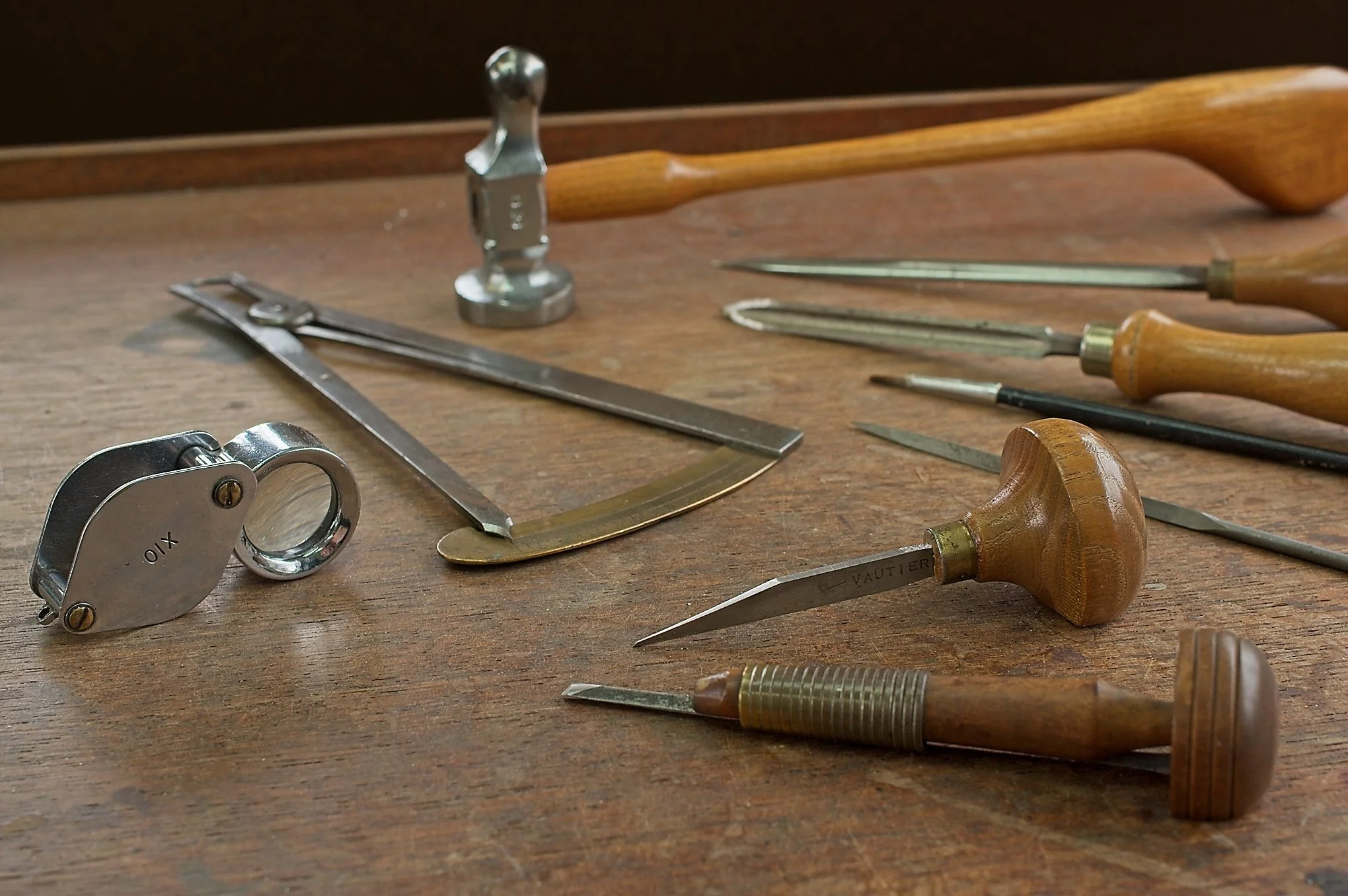
Brian’s apprenticeship in London was as a “Goldsmith and Diamond Mounter”. He is Chairman of the Goldsmiths Guild of New Zealand and is passionate about improving skills and giving recognition to high achievement within the trade.
-
Gems have intrigued mankind for the last 7,000 years. Among the first known were amethyst, emerald and garnet. These stones were reserved for the wealthy and served as status symbols. Rulers sealed documents with jewel-encrusted seals which were an expression of their wealth and power
Today, jewellery is bought and worn increasingly for pleasure, in appreciation of its beauty.
For one of the large number of minerals to qualify as a precious stone it must be transparent, sufficiently hard and sufficiently rare.
Because the diamond fully meets all of these criteria, it is considered the king of all the precious gemstones.
-
Engagement rings date back to ancient Egyptian and Roman times, symbolizing eternity and contractual commitment. The first recorded diamond engagement ring was given in 1477 by Archduke Maximilian of Austria to Mary of Burgundy. It featured thin diamonds in the shape of an "M".
-
The wedding ring has a long and mysterious history, originating in ancient Egypt where rings were fashioned from reeds, rushes and papyrus growing on the banks of the Nile.
The ring is, of course a circle, symbolising eternity. The Egyptians wore it on the fourth finger (digit) of the left hand due to the “vena amoris” (vein of love) myth, which claimed this vein led directly to the heart. While modern science has disproven this connection, the tradition persists as a powerful symbol of eternal love.
Following Alexander the Great’s conquest of Egypt in 332 B.C., this tradition was adopted by the Greeks and later passed to the Romans. Ancient Roman wedding rings were often made of iron, representing strength and durability, before transitioning to gold to signify wealth, purity, and lasting commitment.
The medieval English custom of wearing a ring on the left, fourth finger continues today.